Digital Ethnography — GENGCHEN LIU

Digital enthropology is a technology, which is a method of studying virtuality, which can solve the problem of virtual objects in its way. It is based on participant observations. Although what we are exploring is undeniable facts, our task is to understand and explain what is happening in society and how society operates. But sometimes most of the work is still confusing the boundary between offline and online environments. Researchers have reflected on the concepts of virtual and actual, and some even believe that the boundaries between the two tend to blur and merge. Online and offline are increasingly inseparable. However, Boellstorff refuted this illusion in Chapter 2 and claimed that the gap between them still exists. Moreover, he thinks if it is a computer program through the Internet. In the virtual world, we usually have an avatar that can interact with other logged-in people around the world. At the same time, even if the individual turns off the computer, the virtual world still exists because it is located in the “cloud” on the remote server, and he believes that the research can be completed entirely on the network.

The researchers also spent much time studying virtual second life, because the participants observe a long-term process just like learning the language. Furthermore, this process may not necessarily improve the accuracy of the research results. In the research process, the researcher enters a specific environment to observe people and interact with them. In the case where each virtual world participant is a real person, the observed person may be more willing to express more real ideas instead of disclosure of personal identity to the public, and this process may mislead researchers. Therefore, digital enthropology can only be regarded as a framework and methodology to avoid a large number of biases in the research process of researchers. He also believes that numbers and enthropology need to be rethought.

Reference:

Boellstorff, Tom. 2012. “Rethinking Digital Anthropology.” In Digital Anthropology, ed by. Heather A. Horst and Daniel Miller. 1st ed. 39-60. Bloomsbury Academic. <http://www.socsci.uci.edu/~tboellst/bio/Rethinking.pdf>.
Digital Ethnography — Yaodong Jia

Digital ethnography is a way to study human behavior through participant participation in observation. As a technology, digital anthropology can stimulate the original intention of researchers to digitize and provide a specific method for studying human online culture. Participant observation is the core method of digital anthropology. It requires researchers to enter a specific environment to observe people. Interaction with people. The author Tom Boellstorff did not use numbers as research objects, but as methodologies. He hopes to rethink digital anthropology by studying the relationship between virtuality and reality.

The current digital world of the Internet tells development that people are relying on the Internet in any way. “Second Life” is one of the biggest games in these virtual worlds. There is no doubt that the game of Second Life is the place of human culture realized through the Internet and computer programs. One of the greatest advantages of the ethnographic method is that researchers can adapt to specific environments at specific times. The author Tom Boellstorff hopes to study the behavior of people in the virtual world in this game through digital ethnography . The author introduces his personal experience in the Second Life Ethnography, which allows us to better understand the virtual and practical boundaries and relationships. Residents of Second Life create communities, buy property and houses, attend concerts, party in bars, attend weddings and religious ceremonies, buy and sell virtual goods and services, find friendship, fall in love-the possibilities are endless, and everything meets through computer screens To. On this virtual platform, people can put aside the shackles of reality and express themselves more realistically, which helps researchers to better collect data and better study human culture. In connection with today’s special situation, due to the spread of the global epidemic, almost everyone took the initiative to isolate themselves at home. The original behavior order in real life was broken, but another game became popular. Animal Crossing is a series developed by Nintendo Intelligence Development Headquarters and released by Nintendo. In the game, players live in a village inhabited by anthropomorphic animals and carry out various activities. The series is famous for its openness, and it uses a lot of built-in clocks and calendars of game consoles to simulate real time. The virtual world in a special period can better reflect people’s potential behavior habits from the side.

However, digital ethnography does not bring accuracy. In the research process, even if each virtual world participant is a real person, people may be more willing to express more real ideas without exposing their identity to the public, but at the same time, people are also easier Hide your real language and body expressions. The author Tom Boellstorff sees digital anthropology as a framework that avoids the notion that researchers are at risk during research and conceptual errors that unconsciously depend on their own cultural background, Especially when it comes to the future. I suspect that people, things and things in the virtual world may reflect reality and predict reality to some extent.

Reference:

Boellstorff, Tom. 2012. “Rethinking Digital Anthropology.” In Digital Anthropology, ed by. Heather A. Horst and Daniel Miller. 1st ed. 39-60. Bloomsbury Academic. <http://www.socsci.uci.edu/~tboellst/bio/Rethinking.pdf>.
Digital Ethnograhpy-Wanlu Jiang

Digital ethnography opens up more opportunities and enables researchers to understand participants behavior with qualitative online data in more ways than before. Ethnography is not a method, it is the written product of a set of methods combine elicitation methods such as interviews and focus groups with participant observation, which, as a method not predicated on elicitation, allows us to study the differences between what people say they do and what they do (Boellstorff,2012:54). Boellstorff (2012) argues that participant observation is the core method of any ethnographic research project. As Leach said, the essential core of social anthropology is fieldwork (Leach in Boellstorff, 2012:42). Leach emphasized that anthropologists must attend to the ‘principles’ shaping everyday life. For example, Boellstorff uses his own research for participating into the virtual world ‘Second Life’ to argue that amidst the analysis of virtual communities, the use of elicitation methods alone such as interviews or focus groups does not allow the research enough scope for a successful analysis (Boellstorff, 2012:54). What interviews and other elicitation methods can never reveal are the things we cannot articulate, even to ourselves.

Digital ethnography also takes time to do the research. There is no way the researcher could have become known to a community and participated in its everyday practices in such a compressed time frame (Boellstorff, 2012:55). Boellstorff spent three years in the virtual world ‘Second Life’ for his research. Time is necessity for digital ethnography. In order to get to know people’s practices, struggles and their own views on the world, researchers should spend their time trying to fit the facts of the objective world into the framework of a set of concepts which have been developed a priori instead of from oversation (Leach in Boellstorff, 2012:56).

Reference: Boellstorff, Tom. 2012. “Rethinking Digital Anthropology.” In Digital Anthropology, ed by. Heather A. Horst and Daniel Miller. 1st ed. 39-60. Bloomsbury Academic. <http://www.socsci.uci.edu/~tboellst/bio/Rethinking.pdf>.
Digital Ethnography: Weeks 6&7 | Anna Boase

Digital ethnography refers to the application of anthropological data collection methods in both online and offline contexts, it is used to explore both virtual communities and digitally orientated actual communities. Ethnography is not the method; it is the written product of a set of methods. One such method in relation to digital ethnography is participant observation, which is outlined by Tom Boellstorff and exemplified through his own research into the virtual world ‘Second Life’. Boellstorff’s (2012) central argument is that amidst the analysis of virtual communities, the use of elicitation methods alone – such as interviews or focus groups – does not allow the researcher enough scope for a successful analysis (54). He argues that participant observation is the core method for constructing a digital ethnography (54). Here lies one of the key advantages of the method: participant observation reveals the things we cannot articulate, even to ourselves (54). Despite this valuable insight, however, participant observation does come with what could be perceived as a disadvantage – it is a long-term engagement and not necessarily straight forward. Boellstorff (2012) explains that in order to produce a successful analysis, the researcher must become known to a community and participate in its everyday practices, something which is not possible in a compressed time frame (55).

Boellstorff (2012) deconstructs the notion that the actual (offline) and the virtual (online) are blurred and uses digital anthropology as a framework for doing so. He particularly focuses on “the indexical relationships that link the online and offline through similitude and difference” (56-57), alongside the methodological focus on participant observation. Indexicality refers to words or events that lie outside traditional notions of reference because “their meaning depends upon the context of social interaction” (Boellstorff, 2012: 51). Thus, indexicality theorises the bridge between virtual and physical communities. Boellstorff (2012) explains this as “an emergent set of social realities that cannot be straightforwardly extrapolated from the physical world” (52). In essence, virtual communities exist as an extension of physical communities and therefore elements of ‘actual’ society permeate virtual ones. Elements of the physical world contextualise certain words, actions or events in virtual worlds. For example, throughout his analysis of ‘Second Life’, Boellstorff (2012) found that gender shaped many of the social interactions in that it was mainly the men advising the women (46). While most research methods – including discourse analysis and visual analysis – require the researcher to be situated on the outside looking in to maximise objectivity and avoid bias, for digital ethnography researchers must directly insert themselves into the material (communities) they wish to analyse in order to produce a thorough analysis.

References:

Boellstorff, Tom. 2012. “Rethinking Digital Anthropology.” In Digital Anthropology, ed by. Heather A. Horst and Daniel Miller. 1st ed. 39-60.


week4 and 5 writing Gengchen Liu-Visual Analysis

Camera Lucida: Reflections on Photography is a book about photography. This book has nothing to do with the skills of photography, but it has something to do with our spiritual feelings and the vitality of photography.

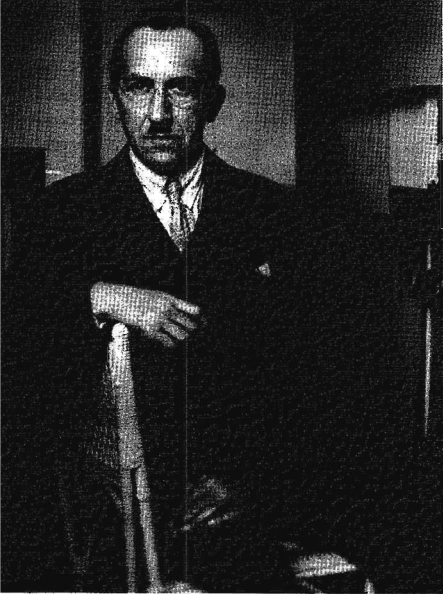
Barthes believes that in order to be a good photographer, they need to master two factors that can hit the audience’s “key”, which are STUDIUM and PUNCTUM. The STUDIUM of the photo is a serious man sitting in a chair but looking forward, meanwhile, the PUNCTUM is When I look at him in the photo, his look to the distance seems to be blocked by something. “How can one have an intelligent air without thinking of anything intelligent? ” is the question under this photo. The question may be relevant with PUNCTUM that always carries some hidden power, which involves what he said in the text. He believes that photography is cruel compared to film, because photography is still, and the stagnation of photography will make people stay in place. Or completely crash. If a person is admiring a work with a PUNCTUM point, when he cannot understand the stinging point of the work, he is painful, he stagnates; when he understands the meaning of the work, he is also painful. because photos cannot help him transfer and resolve emotions.

Returning to the nature of photography, he believes that the essence of photography is “existence”. Recording the essence of photography is the essence of photography. Photography is the first art form that can directly convey history and reality in history, and language cannot be compared with the image. Barthes, a realist, thinks that photography may lie about the meaning of things, but it will never lie about the existence of things. Photography is an expression of real objects in the past. It is not the right way to analyze problems to study whether photos are similar or have moral meanings. Instead, we should consider the proving power of a photo. It is not about the objects in the photo, but about time. Phenomenology says that the proving power of a photo is better than its expressive power. For example, he thinks that a picture is an extensive and convincing evidence as if it is not describing the image it represents but describing its existence. Although the phenomenological image is nihilistic, in the photos, what he proposed is not only the lack of objects but also the lack of objects. Again, with the same actions, the object can be proven to exist.

Photos are everywhere in our lives, but I think we should also know a little about photography. Thanks for this book.

References:

Barthes, R. (1993) Camera Lucida: Reflections on Photography. London: Vintage.

week2 and 3 writing Gengchen Liu-discourse analysis

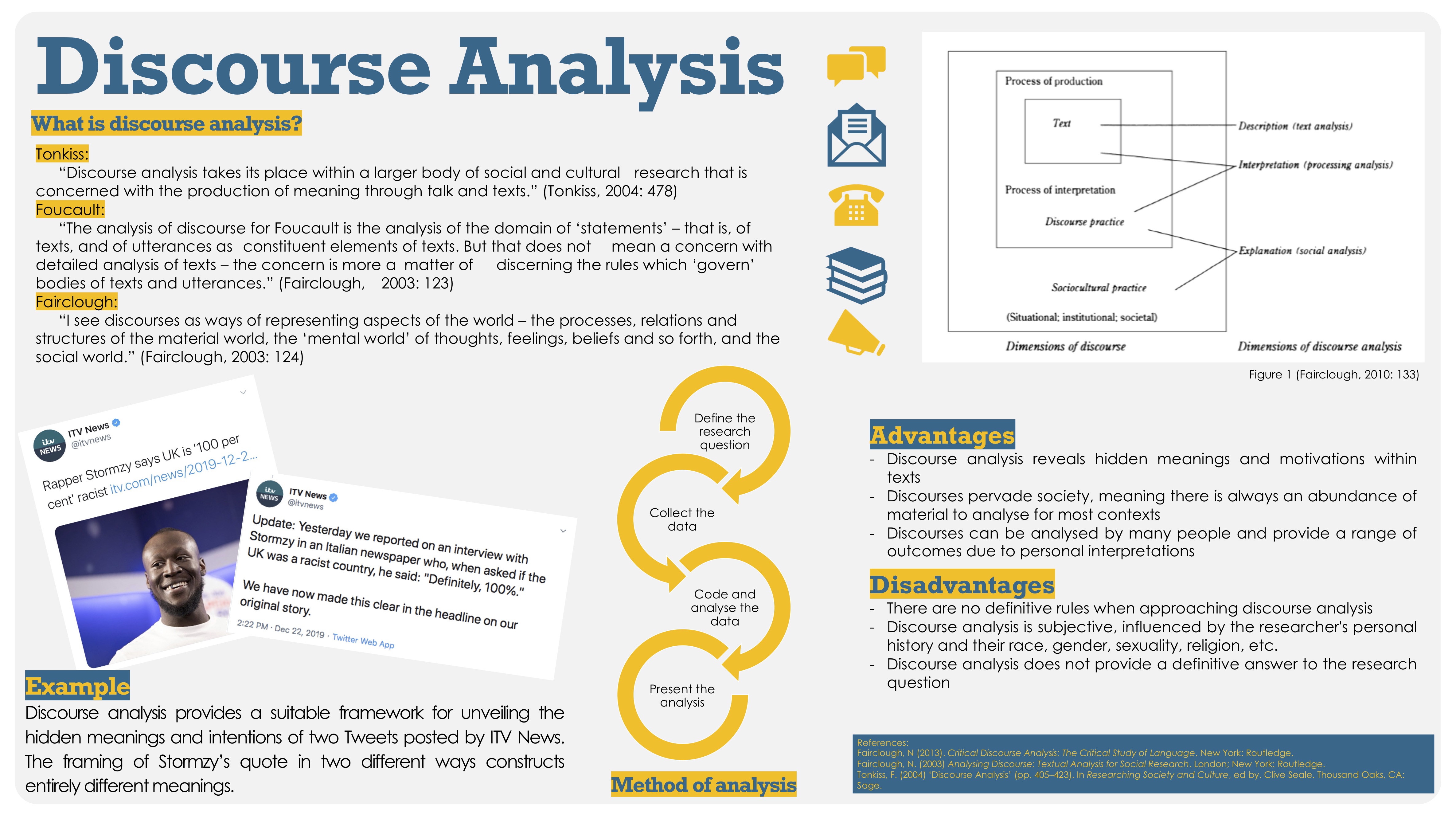
According to Fran’s research, the first difficulty for researchers is to define the research problem. To narrow the selection and research questions is not easy in the initial stage. Moreover, confused about what your research topic and content will cause researchers to be frustrated at the beginning of the project, especially the discourse analysis is usually dominated by qualitative research. But qualitative research is usually done before data is collected. It is therefore difficult to accurately ask research questions before collecting data and preliminary analysis. The second challenge of research is how to select and process data. Especially, researchers often experience data overload in the process of collecting and screening data. Discourse can refer to a single utterance or speech act from a conversation segment, private conversation or political speech. Sometimes, it is relevant with a systematic linguistic order involving specific rules, terms, and conventions. When researchers select and process text data, large amounts of text and data can make them less efficient at processing data. Therefore, it is essential to first consider the relevance of text materials to the research question. The third thing is sorting, coding, and analyzing data. Processing and analyzing data is an essential step in the research process with the support of different theoretical or conceptual frameworks. In this process, it is useful to pay attention to structure and organization, for example, researcher can identify key themes and arguments at the beginning, look for association and variation, then examine characterization and agency, and pay attention to emphasis and silence in the end.

Data and analysis have an important connection with the accuracy of the conclusions drawn, which is why the process of analyzing results is difficult, therefore, in addition to the above three points, whether it can provide authoritative analysis results is also a difficult problem for researchers in the process of presenting the analysis. Because researchers need to describe the data with convincing evidence and official language to better analyze them, researchers usually may ignore specific data, so paying more attention to the details of the text is necessary. Moreover, according to the reference system proposed by Stuart Hall, the reason that the public will form a specific reference system and have a similar denotation of this phenomenon is the media context, audience ‘reference system, the relationship between the media and the audience, and the history facing the society conditional economic conditions, similar or conflicting ideology, all these complex factors have led to the social phenomenon and the social mainstream speech. This directional and holistic complex phenomenon formed a specific social discourse. Therefore, researchers should be as objective as possible and not use the conclusions they want to analyze the process. In order to make the analysis results more authoritative, make a detailed plan, list enough practical questions, and collect data that is more relevant to the problem’s relevance, which can help researchers do better research.

Reference:

Hall S. The rediscovery of ‘ideology’: Return of the repressed in media studies[M]//Culture, society and the media. Routledge, 2005: 61-95.

Tonkiss, Fran. 2004. “Discourse Analysis.” In Researching Society and Culture, ed by. Clive Seale, 405–423. Thousand Oaks, CA: Sage.

Visual Analysis: Weeks 4&5 | Yaodong Jia

Photography has always been a common thing for me, especially in today’s information age, people no longer need professional and clumsy photographic equipment, and almost everyone has a mobile phone with a photographic function. Recording life with photos has become a habit. But it also makes people stop focusing on photography as they used to. People rarely think about the meaning of photography.

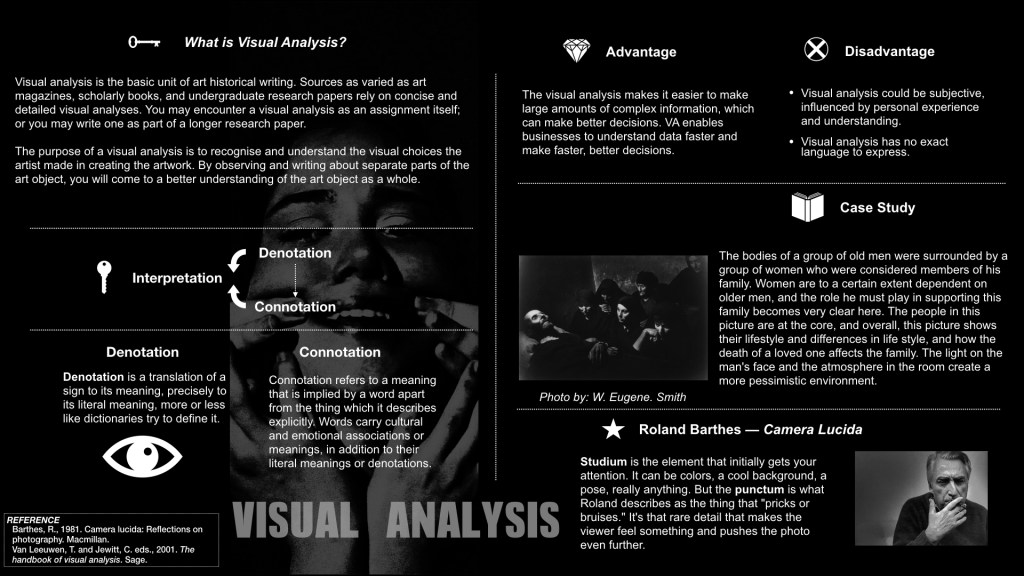
This week’s reading is about photography, but it wasn’t what I expected. At first, I thought I could learn how to take photos, how to capture them, and how to frame them. As a contemporary French master of thought, author Roland Barthes refers to photography as the highest state of thinking philosophy. There are two keywords STUDIUM and PUNCHTUM in his article, they are both Latin. As far as I know, STUDIUM has the meaning of concentration and fluency, referring to the surface features of photos that can quickly attract people. PUNCHTUM has stabbing, detail, and eye-catching meaning, which refers to the strong sensation produced by the viewer of the photo in the stimulation of various details of the photo, which in turn leads to a wider imagination. Roland Barthes believes that some photos are impeccable, smooth and perfect, but cannot be called good photos. It just makes people “like” and belongs to STUDIUM. Only photos that contain PUNCHTUM elements are good photos. There must be some details that can make the eyes stay, can “pierce” the eyes, and the eyes should “hang” to cause the audience to think, such a photo is the real soul. Because of Barthes’s philosophical ideas, these readings are often obscure. In some places, it is necessary to check it several times before you can roughly guess the meaning behind the word. But overall, after reading these articles, my understanding of photography has become deeper.

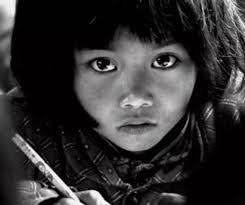
“希望工程小女孩 高清”的图片搜索结果
Example of Visual Analysis:
Denotation: A girl with a dirty face writing with a pencil/Big eyes with tears
Connotation: This photo has a background, at which time China started to implement the “Hope Project”, which aims to establish funds for children in poor areas so that they can have the opportunity to go to school./The character’s eyes with tears expressed a desire and firmness

reference

Barthes, R. (1981). Camera Lucida: Thinking about photography. Macmillan.

Visual Analysis

Wanlu Jiang

There are two parts in Camera Lucida. Roland Barthes (1981) tried to analyze step by step the nature and characteristics of photography in the first part of the book. He said that I wanted to learn at all costs what Photography was “ in itself,” by what essential feature it was to be distinguished from the community of images (Barthes, 1981:3). However, after the emotion was triggered by a photo of the mother in the greenhouse, he raised the feeling of photography to the ultimate problem of experiencing love and death in life in the second part of the book. Barthes (1981) named two elements: studium and punctum, which I think are two key concepts that he wrote in his book. He said that a photograph’s punctum is that accident which pricks me (but also bruises me, is poignant to me) (Barthes, 1981:27). According to Barthes (1981), the definition of punctum is a kind of detail, and it is a precise coordinate and spiritual refinement. A photo without details cannot explain the problem and cannot be expressed. Studium makes viewers have unique feelings because each person’s sensibility is different, and it depends on the viewer’s own cultural background. In other words, how to understand a photo can explain to some extent who you are. Studium is obtained through the punctum in the photo. Photos without punctum may not attract people’s interests, so it is impossible to talk about studium. Barthes (1981) also talked about death, which had two meanings. The first is that people could not help but “pose” because the camera is in front of them, and instantly changes themselves into another person, from the subject to the object, and the second is the certainty of the photo, the subject is taken at that moment, it was fixed on the photo paper forever.

This book is based on the author’s personal emotions and writes some of his feelings about photography. He used several pictures to express his idea of photography, which I think is more about personal feelings, not using an objective method to argue his idea.

Reference list:

Barthes, Roland. 1981. Camera Lucida: Reflections on Photography. First American edition. New York: Hill; Wang.

Design a site like this with WordPress.com
Get started